By: Caleb Miller, Esq.
California employers face substantial new compliance obligations in 2026 following a
legislative session that introduced over a dozen employment-related bills. These updates impose
heightened notice requirements, expand employee protections, and create new avenues for
liability.
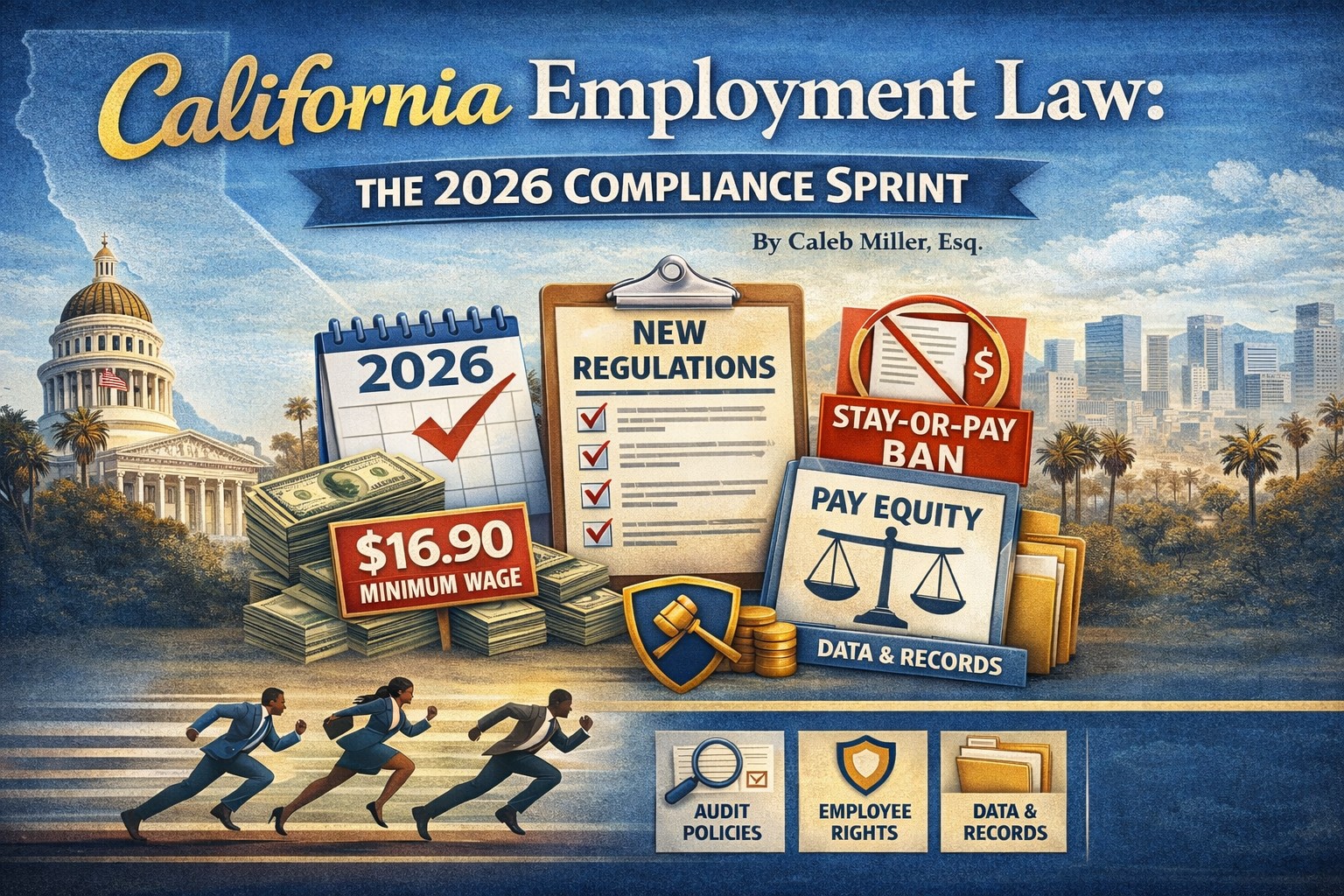
From minimum wage hikes to strict bans on “stay-or-pay” agreements, immediate action
is necessary to audit policies and update agreements. Here is an executive summary of the critical
changes taking effect.
1. Wage and Salary Threshold Adjustments
Effective January 1, 2026, the state minimum wage increases to $16.90 per hour. This increase
triggers cascading effects on exempt employee classifications:
• Exempt Salary Threshold: To maintain executive, administrative, or professional
exemptions, the minimum annual salary rises to $70,304 ($1,352 per week).
• Computer Professionals: The exemption threshold for computer professionals
increases to $122,573.13 annually($58.85 hourly).
o Action Item: Employers must audit salaries before January 1, 2026, to increase
pay or reclassify employees as non-exempt.
2. The End of “Stay-or-Pay” Agreements (AB 692)
California has dramatically expanded its prohibition on restrictive covenants. Effective for
contracts entered into on or after January 1, 2026, “stay-or-pay” provisions—requiring workers to
pay for training or debts if they leave employment—are void.• Exceptions: Narrow exceptions exist for specific tuition reimbursement programs, but
they must meet five strict conditions, including being separate from the employment
contract.
• Risks: Violations carry a penalty of actual damages or $5,000 per affected worker,
whichever is greater.
3. New Notice and Recordkeeping Requirements
• “Know Your Rights” Notice (SB 294): By February 1, 2026, employers must
provide a standalone written notice of workers’ rights to all current employees. This
must be done annually.
• Emergency Contacts (SB 294): Employers must provide employees the opportunity
to designate an emergency contact by March 30, 2026.
• Personnel Files (SB 513): The definition of personnel records now includes training
and education records, which must detail core competencies and certifications.
• Pay Data Reporting (SB 464): Demographic data must now be stored
separately from personnel records. Penalties for non-compliance are now mandatory.
4. Pay Transparency and Equity (SB 642)
• Pay Scale Redefined: Job postings must now disclose the “pay scale” the employer
reasonably expects to pay, rather than a broad theoretical range.
• Expanded Liability: The statute of limitations for equal pay claims is extended to
three years, with a recovery period of up to six years.5. Leaves of Absence and Safety
• Crime Victim Leave (AB 406): Protections are expanded to include time off for
judicial proceedings related to crimes where the employee or a family member is a
victim.
• Data Breach Timelines (SB 446): A strict 30-calendar-day deadline is now
established for notifying California residents of data breaches.
• Pandemic Recall Rights (AB 858): Recall rights for hospitality and building services
industries are extended through January 1, 2027.
6. Industry-Specific and Niche Updates
• Gratuity Theft (SB 648): The Labor Commissioner now has express authority to
enforce tip theft violations through citations.
• AI Whistleblowers (SB 53): New protections prohibit retaliation against employees
of “frontier” AI developers who report catastrophic safety risks.
• Gig Economy (AB 1340): App-based rideshare drivers are granted the right to form
unions and bargain collectively.
• Vehicle Reimbursement (SB 809): A new statute declares that using a personal
vehicle for work requires expense reimbursement (declarative of existing law).
We Are Here to Help
The enforcement mechanisms for these new laws include enhanced penalties and expanded private
rights of action, meaning technical violations can result in substantial liability.
Do not wait until a claim is filed. Our team is ready to assist you with:
• Conducting privileged audits of exempt salaries and pay equity.
• Revising employment agreements to remove unenforceable “stay-or-pay” provisions.• Updating your compliance calendar for the February 1, 2026, notice deadline.
• Reviewing handbook policies regarding leaves of absence and data breaches
Contact Odom Law Group, APLC today at (661) 367-1699 to schedule a consultation
regarding your 2026 compliance strategy.